
USA/Iran War Ends
Was The War Worth It?

A Victory Dressed as a Deal
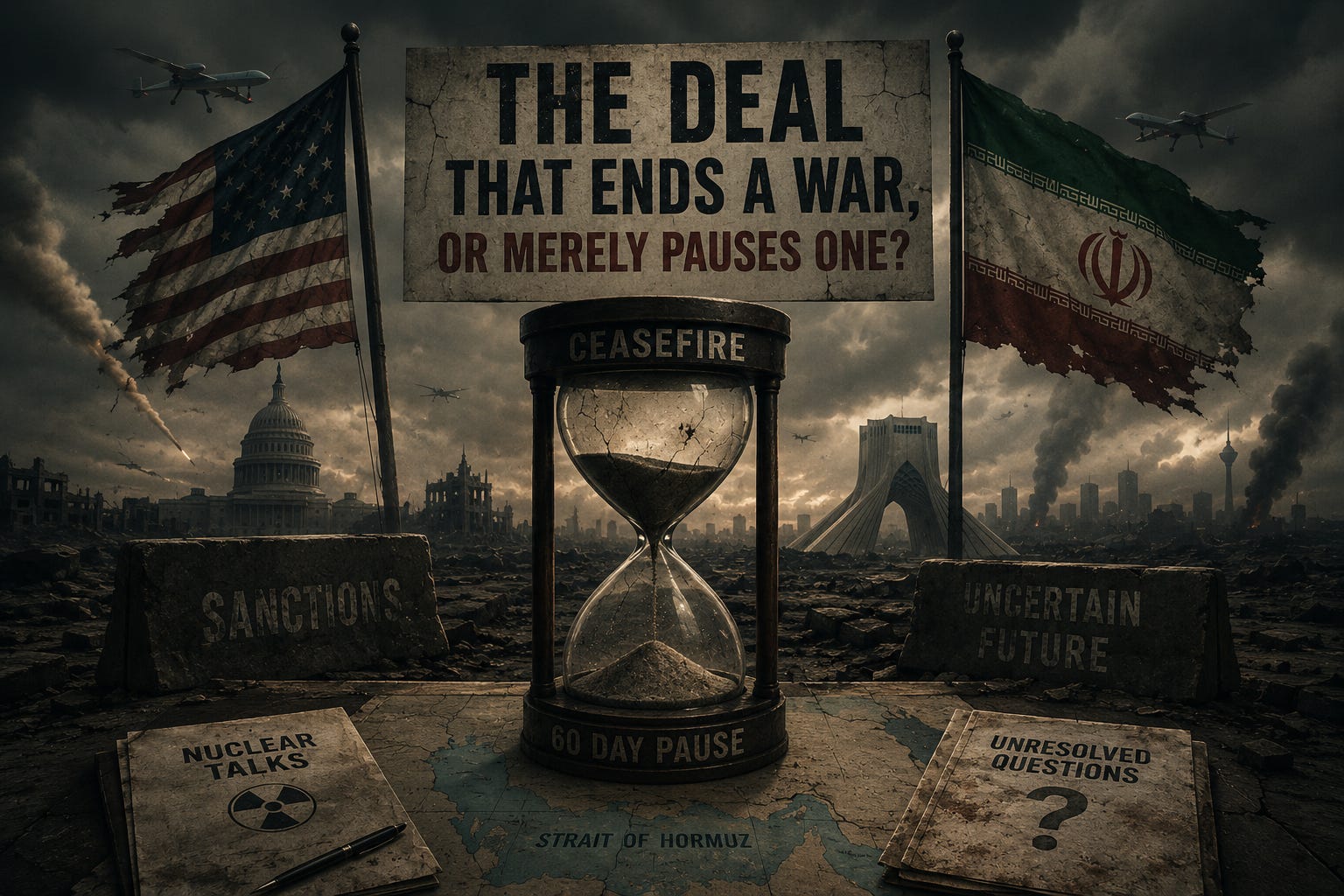
On June 14, Donald Trump announced what he called a “great deal” with Iran. It is one page long. That tells you everything you need to know.
The memorandum of understanding ends military hostilities, lifts the US naval blockade of Iranian ports, and reopens the Strait of Hormuz.  In exchange, Iran commits to a ceasefire on all fronts. The nuclear file, which is the entire reason the war started, has been deferred to a 60-day negotiation period. Details on uranium enrichment levels, centrifuge counts, stockpile disposition, and inspection mechanisms are to be determined.  The deal’s full text had not been publicly released as of June 15.
Compare this to what Trump spent eight years calling a “terrible deal.”
The 2015 Joint Comprehensive Plan of Action was negotiated after talks involving Iran, the United States, the United Kingdom, France, Germany, Russia, China, and the European Union.  It was a massive, highly technical text comprising a main body of 37 pages and five detailed technical annexes spanning another 100 pages, designed to close every conceivable loophole. Iran agreed to go from nearly 20,000 centrifuges to just 5,060 of its oldest, least efficient models at the Natanz facility.  Enrichment was limited to 3.67 percent, enough for commercial nuclear power reactors but very far from weapons-grade.  Iran’s uranium stockpile was capped at 300 kilograms, down from 10,000 kilograms of low-enriched material. Fordow was converted to a research centre with no enrichment permitted for 15 years. 
Verification was a centrepiece: Iran agreed to the Additional Protocol and unprecedented IAEA access, online enrichment monitors, and stringent reporting and inspection regimes that let inspectors track enrichment levels and inventories in near-real time.  A snapback mechanism allowed any signatory to reimpose sanctions without a UN Security Council veto. Independent inspections confirmed that Iran stuck to its side of the agreement.  Trump pulled out anyway.
Now examine what the Trump MOU establishes on the nuclear question. Iran reaffirmed “that under no circumstances will Iran ever seek, develop or acquire any nuclear weapons.”  Iran has been making that precise claim since the 1980s. Neither country has shared the exact terms of the deal. Enrichment, verification, and dismantlement details remain to be negotiated during the sixty-day pause.  US intelligence assessments are already described as pessimistic about Iran’s willingness to make substantive nuclear concessions.  Iran’s Islamic Revolutionary Guard Corps accused Israel of violating the ceasefire 84 times in the first two days after the deal was announced.  Israel’s prime minister confirmed that Israeli forces will not withdraw from Lebanon, Syria, or Gaza.  Iran’s foreign minister stated that continued Israeli military operations in Lebanon constitute a violation of the MOU. 
Iran, meanwhile, has collected its gains. The naval blockade is lifted. The lifting of US sanctions and the release of billions in frozen Iranian funds are on the table during the negotiation window.  The war is over. The nuclear concessions remain a rumour.
Democratic Senator Chris Murphy described the MOU as “essentially surrender to Iran,” arguing that reopening the Strait of Hormuz was not a meaningful concession because it had been open before the war and that providing Iran access to frozen funds before reaching a nuclear agreement could weaken the US position going forward.  He is not wrong. What Iran has conceded, precisely, is unclear, because the document that would tell us has not been published.
Trump withdrew from the Obama deal because it had sunset clauses and did not address ballistic missiles. The MOU he has now signed addresses neither. The Obama deal at least specified numbers. This one is a press release with a signature line.
A 159-page multilateral arms control framework backed by six world powers and verified by the UN’s nuclear watchdog was described by this administration as unacceptable. A one-page memorandum with deferred nuclear negotiations, a fractured ceasefire in Lebanon, and a non-binding verbal pledge not to build a bomb is being called a historic victory. The difference is who negotiated it. The result, for Iran, is functionally the same as winning the war.
Adam Coleman
Sources:
Al Jazeera, June 15 and June 16, 2026
Council on Foreign Relations, June 15, 2026
NPR, June 14 and June 15, 2026
NBC News, June 14 and June 15, 2026
ABC News, June 15 and June 16, 2026
Newsweek, June 15, 2026
CNBC, June 6 and June 15, 2026
Obama White House Archives, JCPOA Key Excerpts, July 14, 2015